By Hannah Mohr, BA ’24
Last summer, three University of Dallas physics students participated in the Amentum
Space Exploration Division (ASED) Internship Program, joining the top four percent
of over 1,000 applicants from across the United States.
Amentum, a global leader in advanced technology solutions, has provided system development and aerospace engineering support to NASA at the Marshall Space Flight Center (MSFC) in Huntsville, Alabama, since 1989. The company’s Internship Program, hosted at MSFC, provided university students with an opportunity to explore new horizons in the field of aerospace engineering, while contributing their research to upcoming NASA space missions. Among these students were Jacob Nalagan, BS ’26, Andrew Newcomb, BS ’26, and Benjamin Vines, BS ’26, each UDallas physics majors.
All interns were placed under the EV42 Guidance, Navigation and Mission Analysis branch, where each was assigned a specific summer research project.
Nalagan, Vines and Newcomb each contributed to research supporting NASA’s Artemis missions. As flight dynamics interns for the Space Launch System, Nalagan studied liftoff and separation systems, while Vines modeled and optimized halo orbits related to the future Artemis Gateway Lunar Space Station. Newcomb worked with the Human Landing System team as a navigation intern, developing a model to help navigate spacecraft by reading the lunar surface.
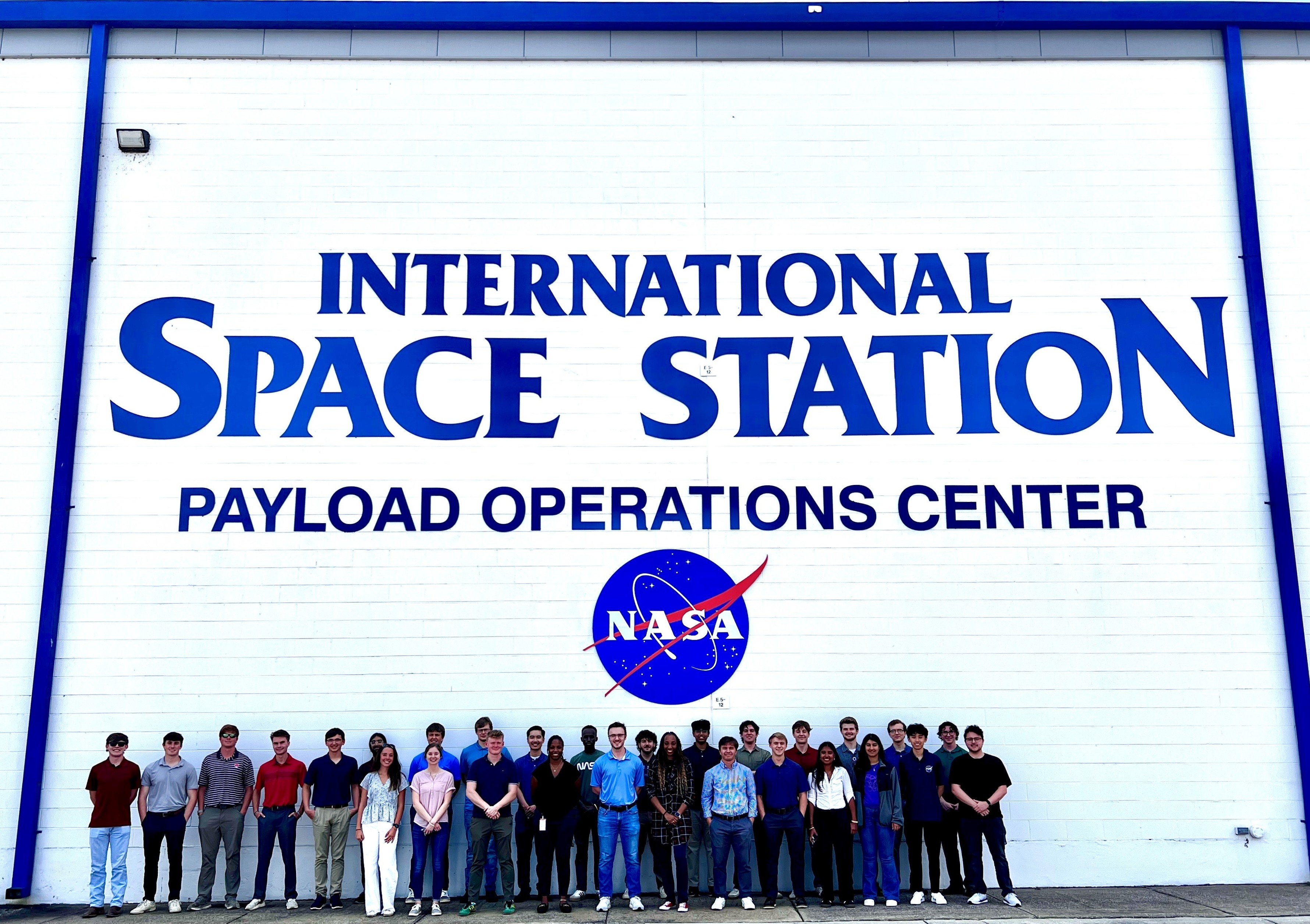
Located at the historical lead field center for the Hubble Space Telescope and the birthplace of the Saturn V rocket and engine designs, the ASED internship program not only offered functional research in aerospace engineering but also immersed interns in the field.
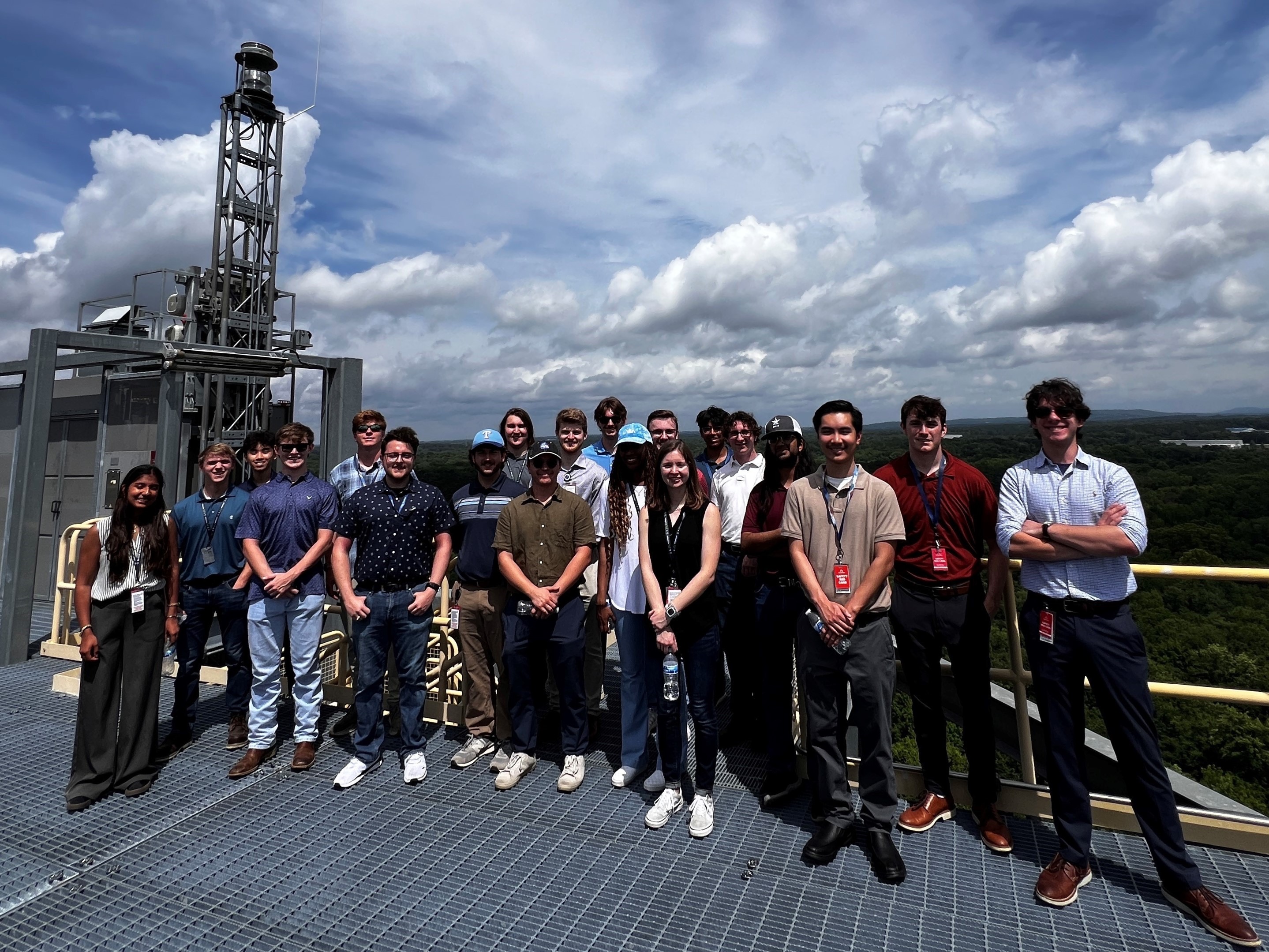
“Not only did we do our work, but we had constant site tours once or twice a week,” noted Newcomb. “We would go and see a rocket assembly building; we would go on top of a 20-story rocket test stand and be able to look out over the whole base. We would see thrust vector control labs, and where they build satellites.”
“I think what was the most fulfilling was getting a real experience in the engineering field,” said Nalagan. “We were given a concrete, boots on the ground, behind-the-curtains look at engineering and how it works. Every day we worked with engineers that were dealing with extremely difficult problems. It was awesome and super cool to see.”
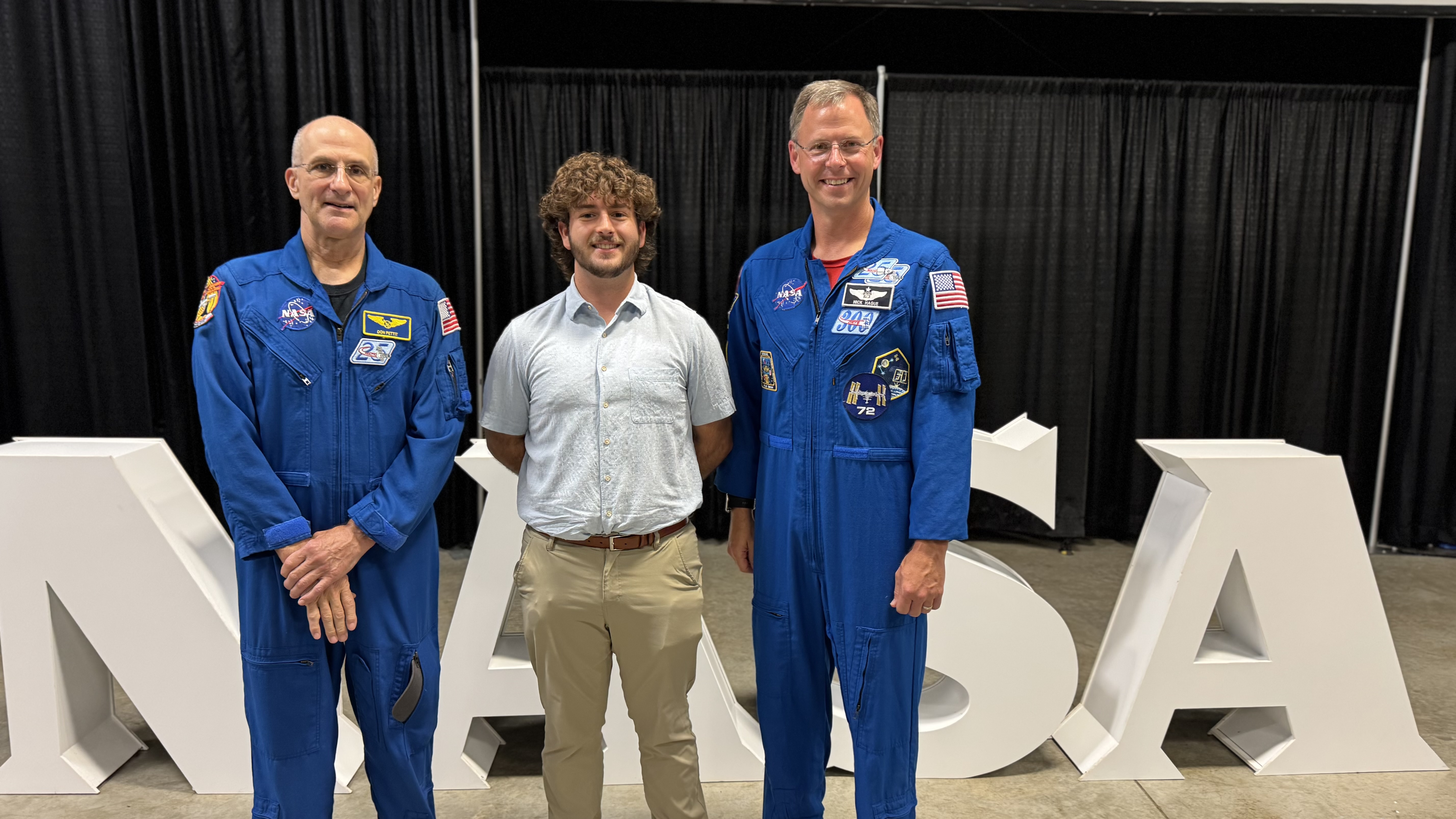
The selected interns were hired and supervised by Peter McDonough, PhD, BS ’10. After receiving his BS in physics from the University of Dallas,, McDonough obtained his MBA and PhD in Mechanical Engineering from Texas Tech University.
McDonough currently serves as Senior Manager for ASED at MSFC, overseeing over 40 employees for support to NASA's EV42 Guidance Navigation and Mission Analysis Branch and managing flight dynamics on some of NASA’s most pivotal space missions such as Imaging X-ray Polarimetry Explorer, Hubble, James Webb and Artemis.
“My team is quite literally at the bleeding edge of the space race, and are the ones crunching the numbers to get Americans back to the Moon,” said McDonough.
McDonough’s career demonstrates that a degree in physics can be foundational for students seeking a career in the engineering field.
“Physics students are problem solvers,” McDonough said. “They may not have domain specificity, but they have the raw intellectual chops to crack difficult space engineering problems.”
The UDallas students represented physics majors in a predominantly engineering-based program. “The three of us were the only physics major interns there,” Newcomb said. “But engineering is really just built on physical principles. If you have the physics down, I think it makes it a lot easier to understand engineering. Even if you don't have practical experience with it, you already really know what's going on foundationally. They're different, but they share all of the same laws of nature.”
“We've had a great background in physics over the last few years,” Vines said. “And that definitely helped prepare us. And I think we showed that a physics major can do the work we were given.”
McDonough believes that his UDallas education was a launchpad for his future: “I couldn’t think of a better preparation for this journey than my education and experience at UD,” said McDonough. “My time there gave me the tools not just to succeed at school, but to succeed with all the problems a real estate owning, entrepreneurially minded, father of four and director of spaceflight has encountered thus far. I’m looking forward to putting Americans back on the Moon, and when it comes, I will thank UD for giving me the education to get that job done.”
“Because our physics department is part of a rigorous liberal arts education program, our physics curriculum is very broad to provide a firm base of physics coursework,” noted Jacob Moldenhauer, PhD, physics department chair. “Our alumni have a strong reputation of performing well at other institutions which speaks to the strength of our program at UD in its preparation.”
The UDallas interns expressed their appreciation for the university’s unique approach to education as well. “I think the culture at UD and the standards they hold us to definitely help prepare you for something like this, especially for learning so much on the fly,” said Vines. He added, “It's a really rigorous program, and we get a lot done as far as research, especially with the amount of resources we have. We even work with CERN and a few other laboratories in Europe to do nuclear research. I worked on that last year.”
“I think the way in which the Core Curriculum has influenced me in loving physics and engineering,” said Nalagan, “is that it's led me to love it in a way that I don't think I would have been able to without being a well-rounded student. If I can find value and beauty in subjects that I don't see myself pursuing, then I can see the beauty of what I am pursuing even more.”
UDallas currently offers official 4+1 partnerships in Materials Science Engineering, Biomedical and Electrical Engineering with the University of Texas at Arlington (UTA). Students pursuing mechanical engineering, like Nalagan and Newcomb, are helping pave the way toward a future 4+1 agreement in mechanical engineering through their coursework in partnership with UTA.
“UD doesn't have an engineering degree,” said Newcomb, “but I'm hoping that people will know that it's possible to go to UD, get the Core, get the Catholic environment and still become an engineer at the end of the day, if that's what you want to do.”
When asked how they felt this internship shaped their future endeavors, the UDallas interns came to similar conclusions.“This was a fantastic experience,” said Nalagan, “it was a blessing beyond compare that we got this internship. This summer, I found that I really love the field of aerospace engineering. I love it and I would love to go into it.”
“I wasn't really dead set on doing space stuff like a lot of people are, but I think after this summer, I would really want to go into aerospace engineering fields,” said Newcomb.
“My plan is to go to grad school, to get a master’s in aerospace engineering,” said Vines, “I definitely hope to make a career of it.”
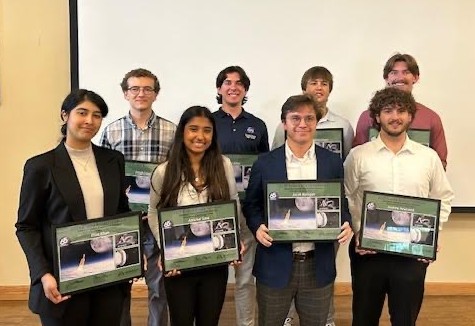
At the conclusion of the internship, each intern provided a 30-minute presentation of their research to the engineers at MSFC. Nalagan, Newcomb and Vines also presented their summer research at the fall 2025 Joint Meeting of the Texas, Arkansas, Oklahoma Section of the American Physical Society.
That momentum will continue this summer, as Andrew Newcomb, returns to ASED and Dominic
Villalobos, a rising senior physics major, joins him in representing UDallas in the
program.